
Lucidchart, when…
- You want one managed platform for the company
- You import Visio files
- You link diagrams to live data
Lucidchart vs draw.io
Both draw any diagram you can think of. Lucidchart wraps it in a managed, collaborative platform; draw.io gives it away free and lets you keep the files. Here’s how they compare, and where an AI canvas fits.
Works in your browser · No card · Free while it’s new
In short
Lucidchart is a polished, paid diagramming platform with templates, Visio import, data-linked diagrams, Lucid AI and enterprise admin. draw.io (diagrams.net) is free, open-source diagramming with a desktop app and files kept in your own storage. Pick Lucidchart for an all-in-one managed platform, draw.io for free and open, or Builderii if you want AI to draw and change diagrams with your team live, with draw.io files in and out.
Side by side
| Feature | Lucidchart | draw.io | Builderii |
|---|---|---|---|
| Best for | A managed, enterprise diagramming platform | Free, open diagramming you control | Diagrams drawn and changed by AI, live with your team |
| Shape libraries | Large, with UML, BPMN and more | Very large, with UML, BPMN, network and cloud | Flowchart, sequence, database, architecture and UI kits |
| AI | Lucid AI | A Generate tool for diagrams from a prompt | Nine kinds of diagram, changed in place |
| Live collaboration | Yes | Through your storage or host app | Yes: cursors, comments, roles |
| Offline desktop app | No | Yes | No |
| Price to start | A free plan with limits | Free and open source | Free, with every feature |
Compared from each product’s public pages in October 2026; features change, so check before you decide. Product names are trademarks of their owners. Builderii isn’t affiliated with or endorsed by them.
Which to pick
Lucidchart is a mature, polished diagramming platform: lots of templates and shape libraries, Visio import, diagrams linked to live data, Lucid AI, real-time collaboration, and integrations with Google Workspace, Microsoft and Atlassian, with enterprise admin.
The trade-off is cost: the free plan has limits, and paid plans are per user.
draw.io, also called diagrams.net, is free and open source, with very large shape libraries (UML, BPMN, network, cloud), an offline desktop app, and files saved to your device, Google Drive, OneDrive, GitHub and other storage. It also plugs into Confluence and Jira.
The trade-off is polish: collaboration depends on where you store the file, and drawing is mostly by hand.
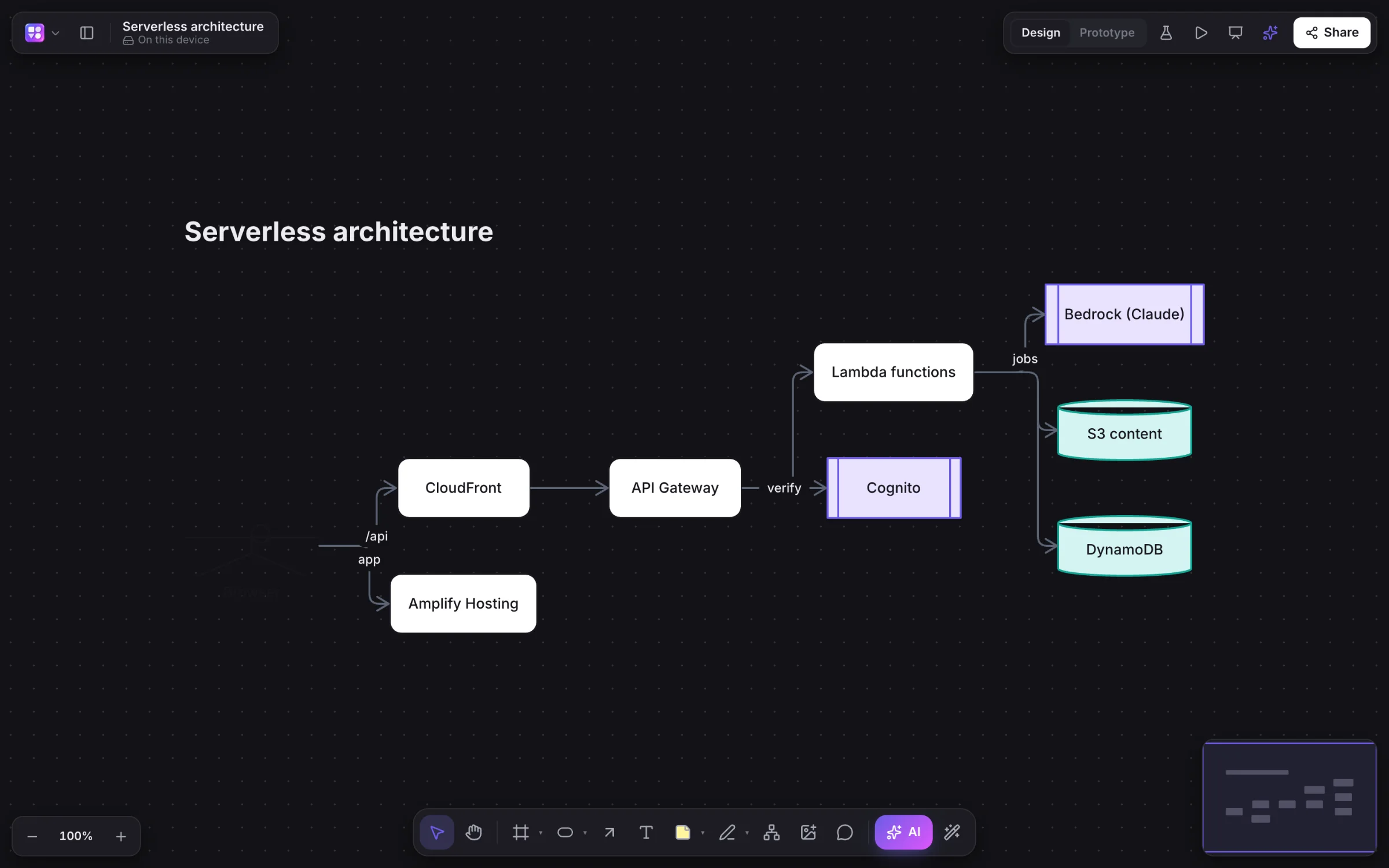
Builderii is for teams who want diagrams drawn for them: describe a process, a sign-in sequence or a schema and its AI draws it with real layout engines, then changes it when you ask. Your team edits live with cursors and comments, and draw.io files go in and out, so you’re never locked in.
Questions
Yes. draw.io (diagrams.net) is free and open source, on the web and as a desktop app.
Lucidchart is more polished as a managed, collaborative platform with templates, data linking and admin. draw.io is free, open and keeps files where you choose. Which is better depends on whether you value the platform or the price and control.
Yes. Builderii imports .drawio, .xml and .drawio.svg files as editable shapes, and exports draw.io back.
Yes. Builderii is free while it’s new, with every feature on and 200 AI jobs a month per person. Viewers and commenters will always be free, and paid plans will publish their AI allowances.
Keep reading

Start with a prompt, a template or a blank board. It’s free.